what is real?

IMG_7164.JPG

Waking from a dream. What is real? I crawl under the crook of Pete’s arm. Nestle in, lay my head on his heart. This is real. I focus in on the details of the room. The morning sun hiding behind the stirring curtain. The warm wind. The whirr of the air-con. The horns on the street below. My breath. My skin. The ache in my neck. The morning. The day. The small smile that softens my face as I remember. This is real.

I hate waking from a bad dream. Or not even a bad dream. Just one with an old friend, someone you once wronged, an unwound knot, a knotty wound, a haunting. Tight around your throat, you wake up agitated and upset. What is real?

This has been my mantra for the last couple of weeks. It came through in a meditation. Perhaps I’d been caught up in some story. I can’t remember but it’s stayed with me. When walking down a hectic Indian street, the only foreigner in town, all eyes on you, it’s easy to feel awkward, different, afraid. Am I too white, too tall, are my bare arms offensive, is it ok to smile, is it appropriate, do I disgust you, am I provoking you, do you hate me. It’s all too easy to project my insecurities onto the blank faces and staring eyes.

What is real? My footsteps. My breath. The layers of noise closing in and pulsing out. The heat. My sweat. The eyes. The people. The people looking at me. This is real. But that is all.

“Watch your thoughts. Feel your feelings”. Wise words from my teacher, Leila. Pulling the two apart helps to keep us present to what is actually happening. It keeps us connected to ourselves. Helps us to steer clear of the storyline and stay on the feeling path. What is true right now? What is real? What are the facts? What is happening in your body? What voice are you listening to? The one in your head or the one that runs deeper. Your intuition or your conditioning? The one that’s coming from the root of your heart or the one that came from someone-somewhere-sometime.

In many yogic traditions, this dance with reality is understood through the concept of Maya. Often translated as appearance, illusion or ignorance, Maya is the veil that covers our real nature. The veils that lead us into storyland and away from centre. Away from our felt state. Away from what is actually happening. For me, meditation is the practice of witnessing the veil lift and fall, lift and fall, as I pulse in and out of centre, as I watch my thoughts and get to know my patterns. This new mantra is part of breaking those patterns, noticing where I get scared, being ok with being scared but staying curious as to who is scaring who. I’m pretty sure, most of the time, I am the one scaring me.

What is real?

It’s deeply grounding and soothing to respond to that question and I can do it anywhere, anytime. When I get stuck in my head or feel anxious about what happened or what might happen, I ask, what is real? I anchor into the sounds, smells, sensations and stimulus. I let them carry me into Presence. I feel my feet, connect to my breath, move into the moment, and ask again, what is real?


Compassion in action

FullSizeRender.jpg

“Don’t just do something, stand there.”

Buddhist saying

The Indian Ocean beats down on the beach, relentlessly dragging the shoreline back and grinding the sand with its frothing mouth. Ravens squawk and shit in the eaves of the thatch and wild dogs howl indiscriminately at passing scavengers. The sun is seething, flattening the sea breeze, while Pete and I sit on the rough hewn cement of our two-storey hut, taking shade and eating a breakfast of idli pancakes.

We’re discussing the book I’m reading, Non-Violent Communication by Marshall B. Rosenberg, and Pete asks if I think there is sometimes a need for violent communication. My sense is that our communication baseline is already violent. We’re brutal to ourselves, criticising, blaming, putting ourselves down and insisting that we should be better than who we already are. The gift of consciousness veiled by the illusion of unworthiness. We place unreasonable demands on ourselves and others. We’re violent in our judgement. We cast aspersions, make comparisons, measure people by our own perceptions and ideas of wrongdoing and rightdoing. And we can be unaware of the violence we bring into our relationships. Wanting to get our own way, wondering why our lovers, friends and family don’t understand us, won’t listen to us, won’t do as we say.

The premise of Non-Violent Communication is based on Ahimsa, one of the five yamas in classical yoga. It translates as ‘do no harm’, which is not to say don’t be boundaried or stand up for yourself, but be alert to your thoughts and actions. The invitation is to listen to what’s really present. To put our own story to one side, whilst becoming more skillful at understanding our own feelings and needs and then those of the Other. Tools and skills that help us to move beyond the communication baseline. To articulate ourselves more clearly, to speak our truth more compassionately, to know the difference between requests and demands and to learn how to deeply listen.

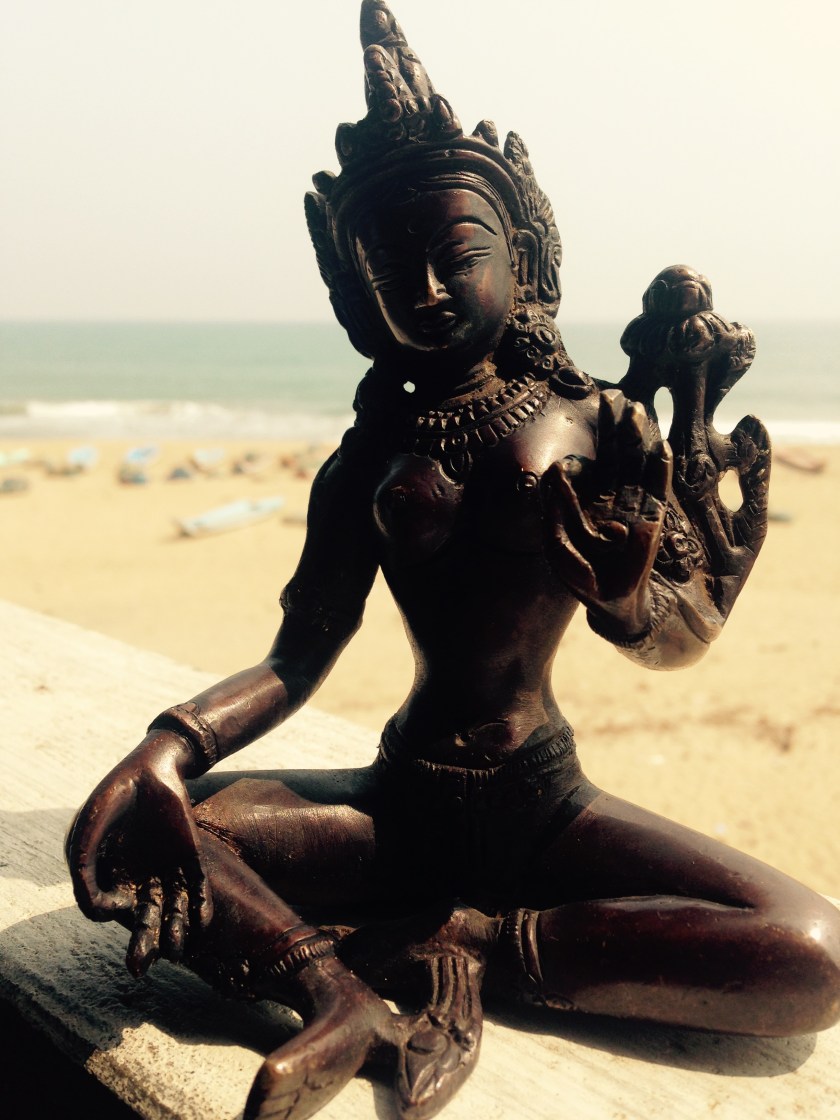
As we sit and talk, a low table lies between us, with a murti of the Goddess, Tara, taking centrestage. Tara represents compassion. Her name means ‘star’, ‘guide’ or ‘the one who traverses’ and as I send my whole self across my makeshift altar, I attempt to traverse the space between us, to be more fully on Pete’s side. To be more compassionate to his feelings and needs by offering up my presence.

“The hearing that is only in the ears is one thing. The hearing of the understanding is another. But the hearing of the spirit is not limited to any one faculty, to the ear, or to the mind. Hence it demands the emptiness of all the faculties. And when the faculties are empty, then the whole being listens. There is then a direct grasp of what is right there before you that can never be heard with the ear or understood with the mind.”

Chuang-Tzu, Chinese Philosopher

When we arrived in Chennai, four weeks ago, the air was thick with diesel and uncertainty. There was no money in the ATMs, my laptop had packed up, I was missing the studio and my feet were yet to feel the hot, dry earth. Inside the first few days, we found ourselves in an arts and crafts shop and this heavy, bronze murti of Tara called to me. Resting in easy pose, holding mudras of fearlessness and openness, she insisted on joining us as we travelled. And, in honor of that, I began a Tara saddhana, chanting her mantra, meditating and journalling each morning, inviting compassion, non-violence and empathy to take root in my heart. Calling my awareness back to that intention as I move through the increasingly hot days. Having compassion with myself, with Pete and with our new friends and experiences.

Non-violent communication is the practice of compassion in action and the refinement of holding space. It’s the skill of ‘emptying our mind and listening with our whole being’. I can sense the shift when I do this and I can hear my harsh language when I don’t. Telling Pete that he ‘should’ do this or offering misplaced advice that is neither needed nor invited. Interfering but believing I’m ‘just trying to help’ and seeing my tendency to control a situation rear its shadowy head… before remembering to be compassionate with myself again.

Rosenberg presents the following examples of how we don’t listen empathically or truly hold space. How we try to fix things when someone just wants to be heard and held.

Advising:                      “I think you should…” “How come you didn’t…”

One-upping:               “That’s nothing, wait till you hear what happened to me.”

Educating:                   “If you just did this…”

Consoling:                   “It wasn’t your fault. You did the best you could”

Storytelling:                “That reminds me of the time…”

Shutting down:           ”Cheer up. Don’t feel so bad…”

Sympathising:             “Oh, you poor thing…”

Interrogating:              “When did this begin…”

Explaining:                  “I would have called but…”

Correcting:                  “That’s not how it happened…”

“Believing we have to fix situations and make others feel better prevents us from being present”. We go up in our heads. Start strategizing. Finding ways to solve things. And it’s not that this is wrong or bad or that we now have to start judging and criticizing ourselves but we can pull back, offer our presence and perhaps notice a shift. What we might find is that our need to solve and fix and advise is more about us than the person we’re trying to help.

“The capacity to give one’s attention to a sufferer is a very rare and difficult thing; it is almost a miracle. It is a miracle. Nearly all those who think they have the capacity do not possess it.”

Simone Weil, French philosopher

When the wifi is strong enough, I’ll share my saddhana and post an online class around the theme of Compassion in Action and we can practice together, across the Indian Ocean. If you want the saddhana, in the meantime, then email me at hello@colyoga.com and I’ll give you the details.


Is this it?

fullsizerender-2-2

Achy, yearning hunger. An appetite for something always out of reach. Something ineffable. Something we must keep searching for. Working for. Hurting for. This indescribable emptiness that hangs low and nibbles away at your would-be satisfaction, as your inwardly overt dissatisfaction resounds. Mildly anxious and just not sure whether you are in the right place at the right time with the right person. Because everything should be right. Right?

I was having lunch with one of my dear friends after class, and this was one of the subjects we landed upon. Is this it? This job, this relationship, this house, this child, this sense that you should be grateful and satisfied but, quite frankly, you’re not. As long as we keep on looking outside of ourselves for what ‘it’ is then we will remain achy and hungry and always looking for something else to quench our insatiable thirst to arrive. To be complete. To get to that place we thought we were supposed to get to.

What about if we started to look within for our answers? And what if we started asking different questions? Like, what is that creative energy that pulses inside of you? What is that life force? That itching, yearning, willful being that wants to know? That seeks for answers? What is that space that sits between your thoughts? And if you’re not your thoughts, or your job or your actions, your name or your beliefs, then who are you?

We each have a purpose. Some souls know theirs from an early age but most of us are still trying to work that bit out. And that’s where the emptiness can really eat you up. What is it that I want? In my experience, those answers can only come from the deepest place in your heart. The trick is learning how to listen.

I’ve had a meditation practice for a number of years and I make sure I sit every day. It’s taken time to build up to that and I’m not dogmatic about how many minutes I sit for, or what time of the day I practice, but I (nearly) always create space to check in, reset and get quiet. I didn’t practice yesterday because I was a bit hungover and I felt bonkers mental inside. Like, seriously. If that’s what it’s like to not meditate then no wonder the world has gone raving mad.

“If we could teach all children to meditate, we could change the world in one generation.” Dalai Lama

There are many ways to meditate, including a myriad of concentration techniques, but the approach I have found to be the most powerful is to not try to control anything. The mind is meant to think. That’s its job.

I was introduced to this style through Adyashanti, and he describes it so clearly in his book True Meditation. Working in this way feels more like an act of generosity where you can separate yourself from your thoughts. Bearing witness to where the mind wanders and gently bring yourself back into Presence when you notice you’ve gone on a merry little journey into headland. It’s amusing to watch your thoughts and rest back into the space behind them. It’s deeply profound to connect to your awareness and it really is pure bliss to come home to yourself in this way. Moving into a bigger space gives rise to insight and allows your intuition to speak up and participate. Adyashanti prescribes the practice of Inquiry; dropping a question into the meditative space can be very powerful and it’s quite magical to see what comes through. Journaling after your practice is a great way to articulate and crystallise your insights and experiences but I don’t always feel like I have time. Which, of course, isn’t true.

We can be resistant to spirituality, often because of its attachment to religion, but many of us are spiritually bereft. We have been led to believe that growth is defined by achievement. By what we can attain outside of ourselves. But even with the perfect job, house and family, if we don’t have the opportunity to commune within, if we are disconnected from the flow of our creative awareness, from the deepest life force essence that is inside each of us, then our satisfaction, and our life force, will wane.

If you feel like nothing is quite cutting it or you just don’t know why you’re here and what you’re supposed to do next. Sit for five minutes. Try to sit everyday and see what happens. Over time you’ll be able to sit for longer and longer and that’s when it gets all kinds of next dimension exciting.

Give it a go.

What have you got to lose?

Want some concentration techniques to get you started? I hear the headspace app has got it going on.

Want to know more about True MeditationBuy it here or learn more about Adyashanti.

Looking for a meditation group in Leeds? I recommend this or come to Yoga Hero on Monday nights and meditate with us there.

The handstand tree

FullSizeRender-2.jpg

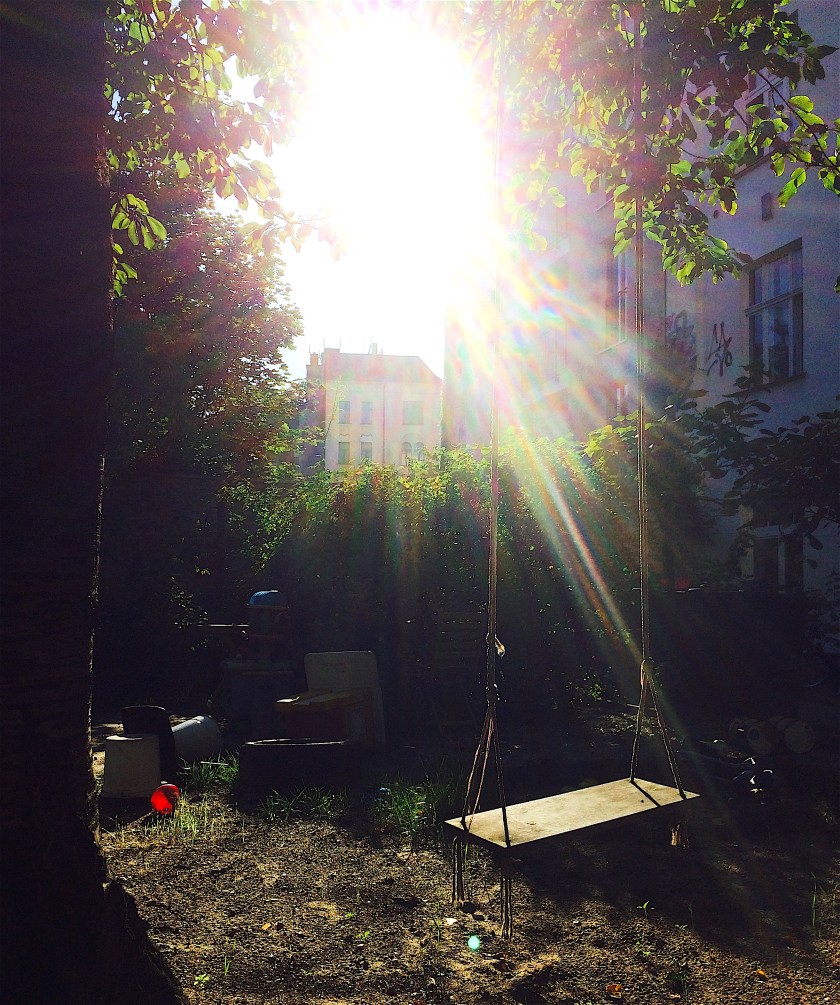
Beyond the threshold of our handmade kitchen lies a small garden, and all I can see is the swing and the handstand tree. The sun warms the earth each morning, and calls me to rise up and meet the day. Walking over the cool pebbles, I find myself delighting in the dirt, seated upon a sheepskin rug and draped in a peat coloured blanket. Right hand to heart, left fingertips to panchamama, I sit beneath the open-armed tree and close my eyes while the birds sing me in and the sun melts through sleepy thought-form-fragments of the dream world.

When I open my eyes again, the swing is perfectly still and silently beckons with the promise of flight. I love a good swing and so I go, to-and-fro, under the canopy, before hopping off and clawing my hands into the earth, kicking my legs and turning myself upside down. Its not everyday I let my inner child consciously lead but when you have a swing and a handstand tree, it’s easy to play.

Play.

What if it was all play? What if all of ‘this’ was the universe expressing itself? A cosmic dance that was all for the taking, whether it felt good or shitty or ecstatic or terrifying. What if those moments of sheer frustration and uncertainty could all be seen as part of the play? “We are a way for the cosmos to know itself,” said the great Carl Sagan and that idea gets me, every time. The Universe isn’t just a pretty place filled with twinkling stars, silvery moons and planets that rain diamonds. It’s fiery and full on and those pretty stars are raging balls of gas and flame. There’s been a tornado on Jupiter that has been stirring its storm for 300 years. The sun, our great star, is both nourishing and destructive. The universe is ever expanding and full of contraction. Our existence is a result of perfect alignment and sheer chance. Space exploded in a cosmic fire and emerged from a point smaller than a single atom. One single atom of potential infinitude. One single atom of endless potential. And there are as many atoms in a single molecule of your DNA as there are stars in a whole galaxy. Now that is a whole lot of potential. Right there. In you.

Life is full of seeming paradoxes but what if we could live inside the whole of it? What if we affirmed all of life and took each and every experience for what it was? Could we allow ourselves to feel our feelings? To wrap our arms around all the parts of ourselves, whether we liked them or not. Could you see the potential that is inside each and every one of those seven billion billion billion atoms that make up the whole of you? You are literally made of potential and at the heart of that potential is the possibility for great joy. To find something that fills you up and helps you taste the nectar of your own being.

In a recent handstand workshop, the playful Hanuman and co-founder of Acroyoga, Jason Nemer, offered up a piece of wisdom that will always stay with me. He said, “fear is, more often than not, unlocked joy.” The fear to dance, sing, play, love, to stand on your hands, peer behind the mask, open your heart, fulfill your potential. Behind that fear is a whole load of joy, just waiting to happen. Behind that fear is endless potentiality. As Neil de Grasse Tyson says in the brilliant Cosmos, “we are, each of us, a living universe”.

There is a swing inside of you that silently beckons, with the promise of full flight. If we can come to delight in the dirt and turn ourselves upside down, we can move beyond our fears to taste the whole of life, in all its nebulous beauty.

everything in relationship

ibizaaprilretreat-064

I’m sat in Pete’s bedroom with the door closed. Everything is white. The strong silence is ringing and I close my eyes to begin the descent. Travelling through tense tissue and frozen flesh, along boiling rivers of muddy blood, accessing the inner reaches of my body until I am fully submerged and come to learn that the tube of my entire torso is on fire. I’ve tasted this experience once before and now know that this is the flavor of fear and anger. Acidic foam. Caustic and surging. I sink into the flames and discover that I feel sick but not in a way that disturbs me. I’m curious. Fear and anger manifest as sickness in my body and as I track the embers to the pit of my stomach I’m strangely pleased with this affirmation. I fuse out and my head takes over. I’m inventing a conversation and fuelling a reverie before I realize and send myself back to sit beneath the acid tree. The journey is cooling and it calms me to travel through these rivers and streams and move into the experience. I ask my body what it needs … breath. Deepest breath. I breathe into the coals, offering more ease, helping the sensation to soften by stroking the inside of my heart. How can I create more space with this breath and how can I bring myself to a place that honours my feelings but clears my head?

My head wants my voice to be heard. I have so much to say … but my body wants to me listen. So I sit a little longer.

Feeling your feelings is shaky work. Going into your body and tracking those elusive articulations takes the skill and patience of a hunter. Sitting, waiting, watching. Returning to the battleground and scouring the landscape of your anatomy to wash and cleanse the killing fields. Observing yourself in relationship to others and looking for repeated patterns of behavior. Hungry to break old cycles and cultivate new neural pathways. Understanding what is really present at that moment in time, instead of through a distorted lens of past events or future fear. Coursing the emotion through your systems and structures to allow it to pass through. To see where you’re holding it. Where it rises. Where it burns and sears and tears from the inside out. Breathing yourself back to life by expanding from the inside so you can feel your way back in because, somehow, somewhere along the way, you forgot.

We forget that our bodies have wisdom. We forget to listen to what they have to say. We ignore their pleas at the cost of our deepest truths. And a voice that isn’t heard only gets quieter.

“A body whose wisdom

has never been honoured

does not easily trust.

An animal with a crazy trainer

learns crazy habits,

runs wild.”

Marion Woodman

If everything is in relationship then how am I in relationship to myself? My body? My thoughts, feelings and emotions? How does my perception affect my relationship to the world around me and if I shift my perception does the world shift too? Coming into deeper relationship with yourself can have a profound effect on how you communicate, how you see the world and how you interact with everything inside it. But what does that even mean? A deeper relationship with yourself?

When we get curious about why we react in a certain way, who we judge, what we believe. When we explore the different shades of red we can begin to catch ourselves before our knee jerks. Before something harmful, callous or cruel leaps from our suddenly forked tongues. When we begin to inquire we can start to observe and become the witness to our own triggers. I will never forget a class I took online with Elena Brower. It was all about automatic reaction versus conscious response and it has stayed with me and supported me in so many situations over the years. It’s such a beautiful play, so cleanly articulated, and I see myself in this dance, daily. I know when I’ve reacted badly. And when I do, I get curious. I try my best not to judge myself. I work to acknowledge my shadow, dive into my body and follow the emotion so I can taste it, drink it in and ask it to pass through. So I can release the pattern and deepen my intention to respond with greater consciousness. To move from a place of truth and to speak that truth quietly, fearlessly and with love.

To quote my soul sister, Rikke Brodin, “become so fluid that the waves of stimuli and emotion can glide through [you] unbroken and ‘untrapped’”.